
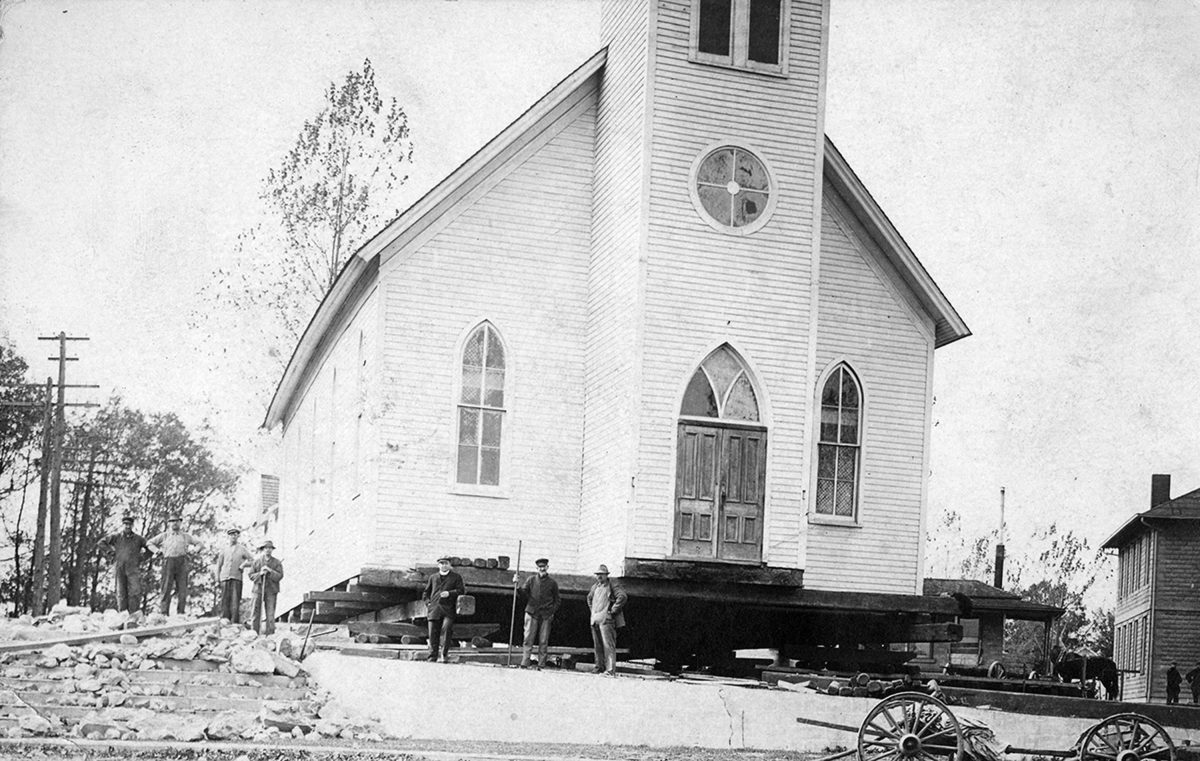
The first Catholic parish at Mount Pleasant, Michigan was established during the early 1870s and was named St. Charles. A real-picture postcard has come to light that shows a church being moved.1 Several clues indicate it may be the first St. Charles Church, shown as it was being moved to a new location.
(A PDF version of this essay is available here. Enter user name “Guest” and password “seemore” when prompted.)
Early History
Exactly when the parish was officially established is probably recorded in diocesan archives. It was initially within the Diocese of Detroit, then the Diocese of Grand Rapids. Today the parish is part of the Diocese of Saginaw.
Parishioners celebrated the anniversary of the parish through the years, but those celebrations imply different years for the founding. For example the thirty-fifth anniversary was celebrated in 1907, implying it was 1872.2 The forty-eighth and fiftieth anniversaries were in 19223 and 19244 respectively, implying the year 1874. The church building itself was not completed until 1877.
In 1871 and 1872 the federal government finally released land grants in Isabella County that had been promised in treaties to native Americans decades earlier. That brought land speculators to Mount Pleasant, which was incorporated as a village in 1875. The speculators who bought native American lands later sold their holdings starting about 1877 causing an even greater increase in population. The Catholic parish had grown too.
According to historical accounts, in the early 1870s a priest would come from a neighboring town like Saginaw, and several families celebrated Mass held at various homes. On August 7, 1872, a prominent local lawyer and later historian, Isaac A. Fancher and his wife Althea, sold three acres of land on Oak Street to Bishop Caspar H. Borgess of the Diocese of Detroit for $500.5 All accounts indicate Mr. Fancher donated the land so he probably did not accept payment. A building committee was organized in September 1874 and on October 31, 1874 they resolved to build a church. It was to measure 38 by 60 feet, and 24 feet high.6
Fundraising, planning and construction of the building took several months and was repeatedly delayed. By January 25, 1875, the firm Brower & Main was to furnish building material for the new church.7 Construction was planned for the “coming season.” Unfortunately the great fire of 1875 destroyed much of the Mount Pleasant business district on August 5th that year. It is likely there were labor and supply shortages while the village was rebuilt. This probably halted construction on the church if it had even begun. The next year in April 1876, the local newspaper editor wondered what had become of the project.8 Finally by July 1876 the frame for the church had been erected. It was said to be a good substantial frame.9
Brief mentions in the local newspaper indicated construction progressed through July, August, and September 1876.10 Then newspaper accounts seem to go silent on the matter. The church was not listed in the directory of village churches published in the weekly newspaper well into 1877. There seems to be only one later mention, that services were held at the Catholic Church on September 5, 1877.11 This implies they were the first services held at the new church.
Apparently it was delayed through the 1875 building season, then the 1876 season, and most of the 1877 season. Throughout this time, there was no resident priest for the parish. Father Richard Sweeney of East Saginaw, Michigan likely visited Mount Pleasant occasionally to say Mass and oversee progress on the church. His journey took one or two days each way. Delays in communication and irregular visits may have incurred delays in construction as well.
Finally, two years after its completion, Father James J. McCarthy was assigned as the first resident pastor of the church on August 27, 1879. He had just been ordained in June. Bishop Borgess visited on September 4 to confer the Sacrament of Confirmation on sixty-two parishioners. Both Fr. Sweeney and Fr. McCarthy assisted.12
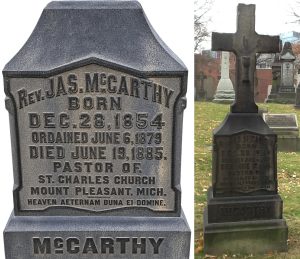
Sadly Fr. McCarthy died six years later on June 19, 1885 at age 30. He was buried in his hometown of Pittsburgh, Pennsylvania.13 His tombstone indicates he was pastor of St. Charles in Mount Pleasant, Michigan.
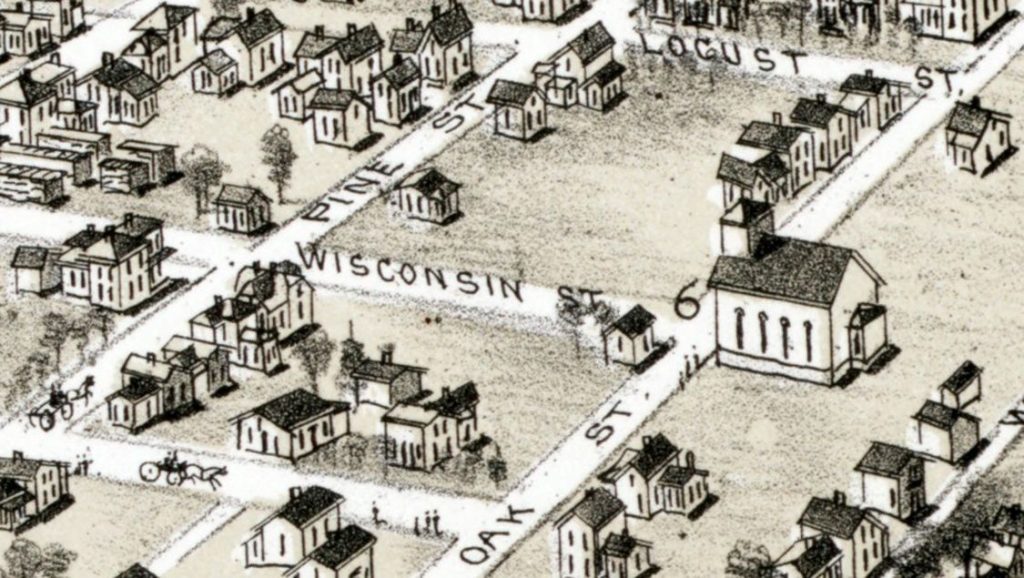
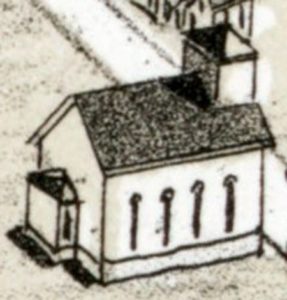
A portion of a bird’s eye view of Mount Pleasant, published in 1884 depicts the St. Charles church (see building 6, on the right).14
A New Church Building
The parish continued to grow along with the village of Mount Pleasant. Word had spread to southern Michigan and as far away as Canada that good, cheap farmland was now available in the county. The first railroad had opened on December 15, 1879. Logging of the great stands of white pine in the area was at its peak by 1880.
About 1883 St. Charles parish probably transferred from the Diocese of Detroit to the Diocese of Grand Rapids. Bishop Caspar H. Borgess transferred the Oak Street property to Bishop Henry J. Richter on May 7, 1883 for $1.00.15
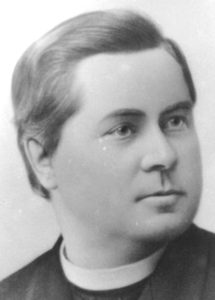
In July 1885, following the sudden death of Fr. McCarthy in June, Fr. John A. Crowley was assigned as pastor. He had been ordained the previous April in Montréal. He studied at Notre Dame (1860-1862), served as a Holy Cross brother, Brother Camillus, for nineteen years, then studied for the priesthood at the Grand Séminaire de Montréal (1881-1885). Fr. Crowley’s ambition combined with the growing congregation, no doubt paved the way for a grand new church building. His experience as an educator was the likely impetus to begin a Catholic school too.
Less than ten years after completion of the first church, the Catholic Society of Mount Pleasant in July 1886 planned for the new church.16 Six months later Bishop Richter purchased an entire city block in Mount Pleasant from Charles and Regina Fantle for $1,600 on January 20, 1887.17 This block, Block 22, was bounded by Franklin, Illinois, Lansing and Michigan streets.
Bishop Richter also sold right-of-way for a railroad on the Oak Street property to the Toledo, Ann Arbor and Cadillac Railroad Company for $125 on June 30, 1887.18 Knowing the property would soon be sold, he gained some income from it prior to its sale. Then on December 29, 1887 the property was finally sold to the Gorham Brothers company for $3,000.19 Gorham Brothers planned to erect a veneering and basket factory at the site. The sale stipulated the church building was not included and that it would be moved by July 15, 1888. It would be moved to Michigan Street in block 22, and used for services until the new church was ready.20
Fr. Crowley gave his annual financial report in January 1888. He indicated the new church would start construction during the year. He then advertised starting in March for bids on construction materials.21 He expected the new church would be ready to occupy in the fall of 1888, at an estimated cost of $15,000.
The job of moving the old church building from Oak Street was given to J. C. Chappell of Saginaw, Michigan and they began in June 1888. By the end of June however, progress was delayed because the building’s weight was too much for the log rollers. The effort continued and by mid July the building was at its new location.22 A newspaper account says they had to cut the telephone wire connecting V. F. Conlogne’s house and store to make way. Fr. Crowley held Mass in the old church on July 22, after the move.23
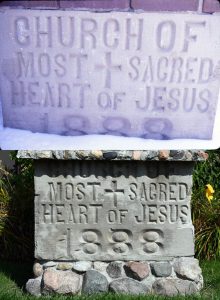
Meanwhile C. W. Churchill had a contract to excavate and build the walls of the new church and the foundation work began in late July 1888. By mid August the foundation was complete and the brickwork began. The new church cornerstone was laid August 22, 1888.24
In late August, framing intended for the church had been destroyed by a fire in Saginaw, but it was quickly replaced and work resumed in early September. By late November the new slate roof had been installed.25 Finally one of the first, if not the first, Mass was said in the new church on Christmas Day 1888. This was just four months after the cornerstone was laid.26
Mass was actually held in the basement of the new building for some time until its grand interior was completed, presumably later in 1889.27 During the same period, the old church building was remodeled and converted to a two-story school. By July 1889 a stone foundation with brick veneer was added. The building was also divided into two school rooms and corresponding recitation rooms, enough to accommodate 200 pupils.28 In those days, classrooms were for quiet study and recitation rooms were for activities and lecturing.
The Feast of the Sacred Heart is recognized as a feast of atonement for known ingratitude towards God. It originated in earnest in 1675 when Christ appeared to St. Margaret Mary Alacoque in France and said “Behold the Heart which has loved men so greatly but which has been given so little love in return.” Pope Pius IX dedicated the whole Catholic world to the Sacred Heart of Jesus in 1856. By 1889, Pope Leo XIII raised the feast to the dignity of the first class.
During this time, and certainly by 1888 when the new church cornerstone was set, St. Charles parish was renamed the Most Sacred Heart of Jesus. The new school, formerly the original church building, opened August 30, 1889. It was likely called Sacred Heart Academy, but that name may have come later. It was also known colloquially as the Sister’s School since it was staffed by Dominican Sisters from the mother house in New York.
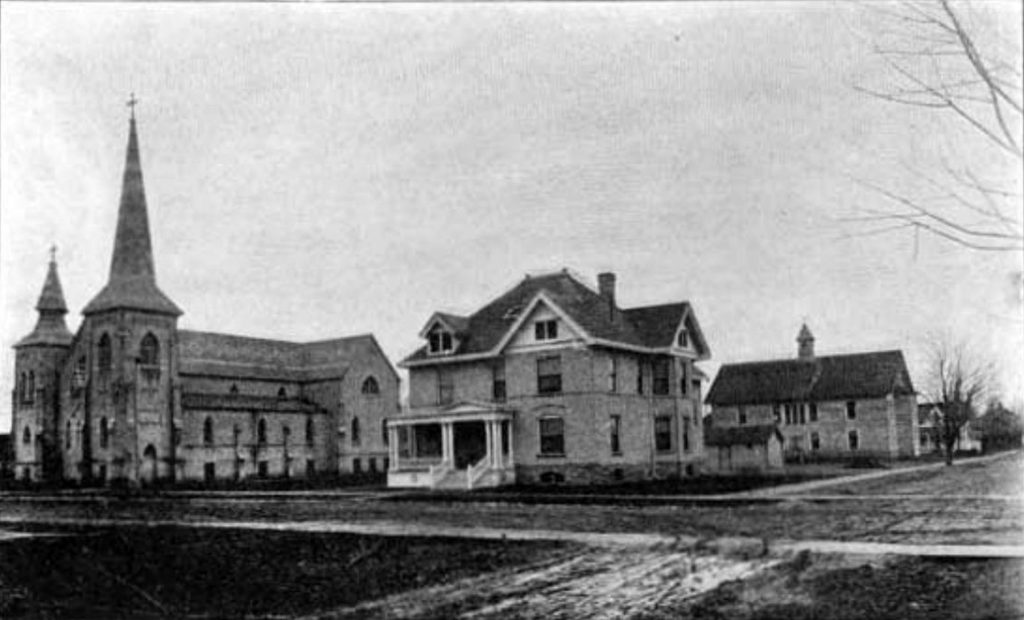
Thus the original St. Charles Church was completed by 1877, then moved to the site of the new brick church in 1888, then remodeled into a school in 1889, which was the newly established Sacred Heart Academy. It is shown in the background in the above photograph taken about 1900.29 Notice the school seems to have been elevated with its new foundation visible as a darker band along the bottom. The windows had also been reconfigured for the various classrooms. The newly constructed rectory or priest’s home is in the foreground, and the new 1888 church is on the left.
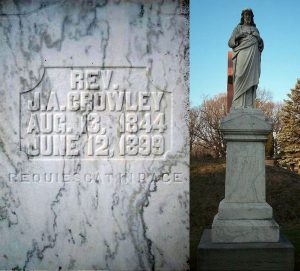
Fr. Crowley continued to serve the parish until his death on June 12, 1899 at age 54. It is said he contracted an illness while traveling through a storm to minister to a dying parishioner. Fittingly, he is buried in Mount Pleasant beneath a statue of the The Most Sacred Heart of Jesus.30
The 1888 church stood for another ninety years. It was eventually replaced by a new church one block away, in 1968. The old church fell into disuse and was boarded up. It was hit by lightning in 1978, which caused a fire. It was torn down shortly thereafter.
The Postcard
Perhaps the only known photograph of the original St. Charles Church is this real-picture postcard. There are some discrepancies however, and also some clues.
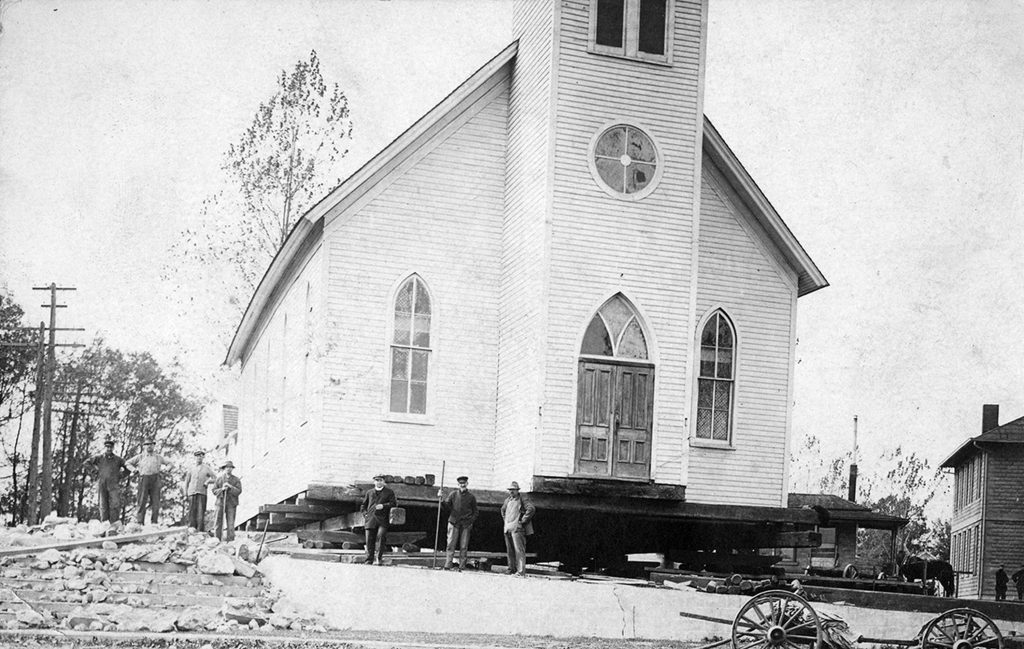
The first discrepancy is, there is no description of what is happening, which church it is, nor even a date or place indicated. The postcard simply shows a church being raised off its foundation presumably to repair the foundation or to move the building. Although it is part of a collection of postcards of Mount Pleasant, Michigan, there is no provenance provided. So it may in fact be another church in Mount Pleasant, or another church in another town altogether.
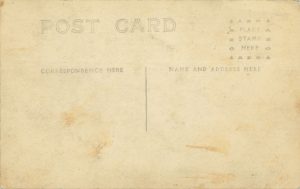
Secondly, the postcard has markings on the back that indicate it was published between 1904 and 1918. Specifically the AZO company logo around the “Place Stamp Here” mark. It is also a “split-back” postcard with an area for written correspondence, which did not come about until 1907.
It is odd that a photograph taken in 1888 would be published on a postcard twenty years later. Usually a postcard celebrates a current event. Perhaps it was in celebration of an anniversary for the parish and there was no other picture of the original church.
There are also clues consistent with the photograph being of St. Charles Church.
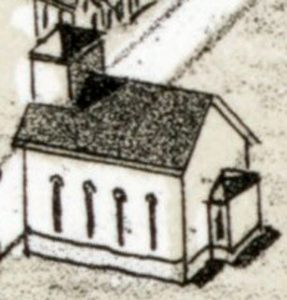
The St. Charles Church depicted in the 1884 bird’s eye view of Mount Pleasant is similar to the church in the postcard. There was some artistic license taken. The steeple appears flush with the front of the building in the drawing, but it juts outward in the photo. There are four side windows in the drawing, but five in the photo. Overall though, both buildings appear the same.
Taking rough proportional measurements from the photograph, I found the width of the building to be about thirty-four feet. The breadth of an average man’s shoulders then was about fifteen inches. I counted about twenty-seven shoulder widths across the width of the building. Twenty-seven times fifteen inches is thirty-four feet. That’s four feet less than expected, but perspective and relative distances in the photo makes it approximate, so it is close to thirty-eight feet.
The plain architectural style of the church was common for that era. There may have been other churches in Mount Pleasant that looked similar. I found no mention of another church being relocated in the historical accounts.31 32
I searched the Sanborn Fire Maps over several years for churches having a similar design.33 The First Presbyterian Church in 1890 (left) near the intersection of Court Street and State Street (where “13” is seen) had the same architecture as St. Charles, but it had apparently not been moved by 1924 (right), although it does appear to have been remodeled.
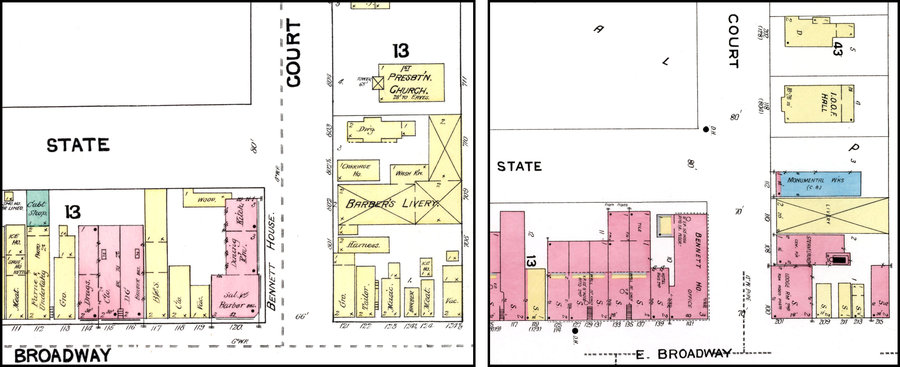
Below, the Trinity Lutheran Church in 1910 (upper) on Normal Avenue had the same architecture as St. Charles, but it too was at its same location in 1924 (lower).
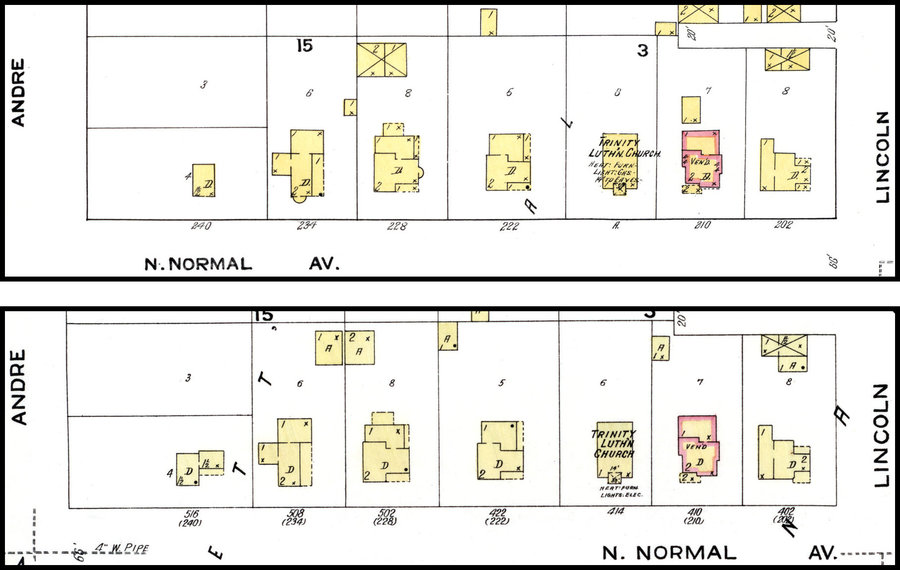
There were other churches shown on the Sanborn maps, but they did not match the architectural style of St. Charles. These included the First Baptist, the Church of Christ, the First Methodist Episcopal, and St. John’s Episcopal churches.
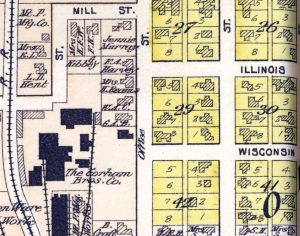
Another clue on the postcard is the building to the right, which appears to be an office building. A later 1899 plat of Mount Pleasant shows a Gorham Brothers office.34 If it existed in 1888, it was indeed right beside the old church at the intersection with Wisconsin Street.
The best clue is the gentleman standing third to the left from the front doors. He looks to be a clergyman with a white collar.
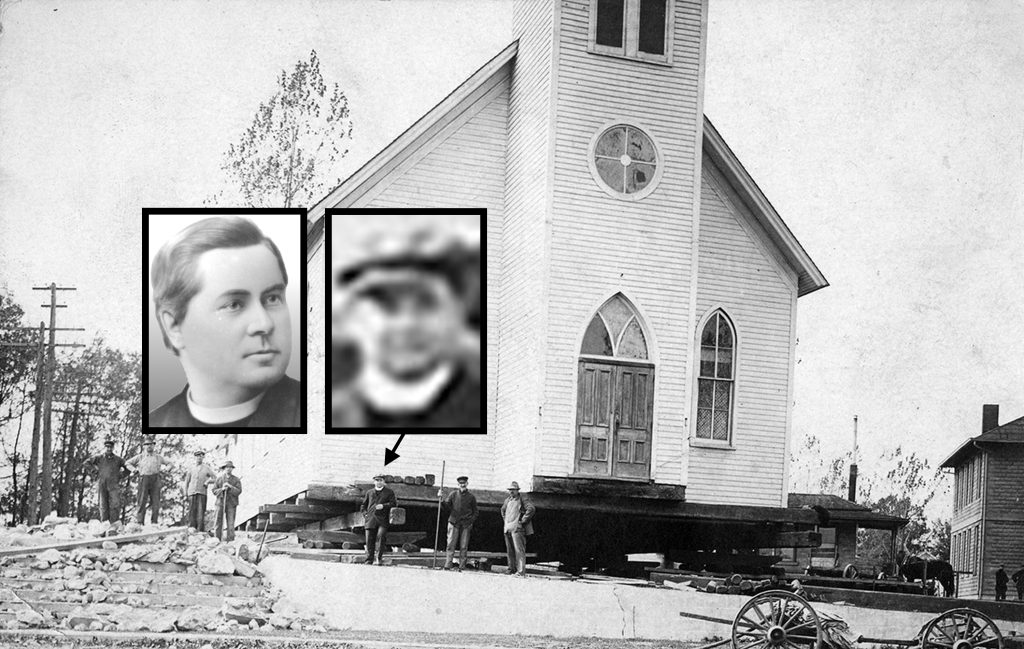
I compared the face on the postcard to a portrait of Fr. Crowley, who oversaw the moving of the church.35 He is out of focus on the postcard, but his features are consistent with his portrait, or at least not obviously different. The full white collar, his round cheeks and rounded chin seem to match.
Conclusion
Given the dimensions and shape of the building, and the resemblance of the man to Fr. Crowley, I conclude the postcard does indeed show the original St. Charles Church of 1877, as it was being moved in 1888, and just before it was converted to the first Sacred Heart Academy building in 1889.36 I cannot say it with complete certainty however. I suspect the postcard was published about 1907 to mark the thirty-fifth anniversary of the parish. If other postcards are found to share the same publisher’s mark on the back, perhaps we could infer they were published as a group to mark an occasion.
Afterword
It is interesting to see how things changed over the years by analyzing the Sanborn Fire Maps. By 1884, the St. Charles Catholic Church, finished in 1877, was still on Oak Street where it meets Wisconsin Street.
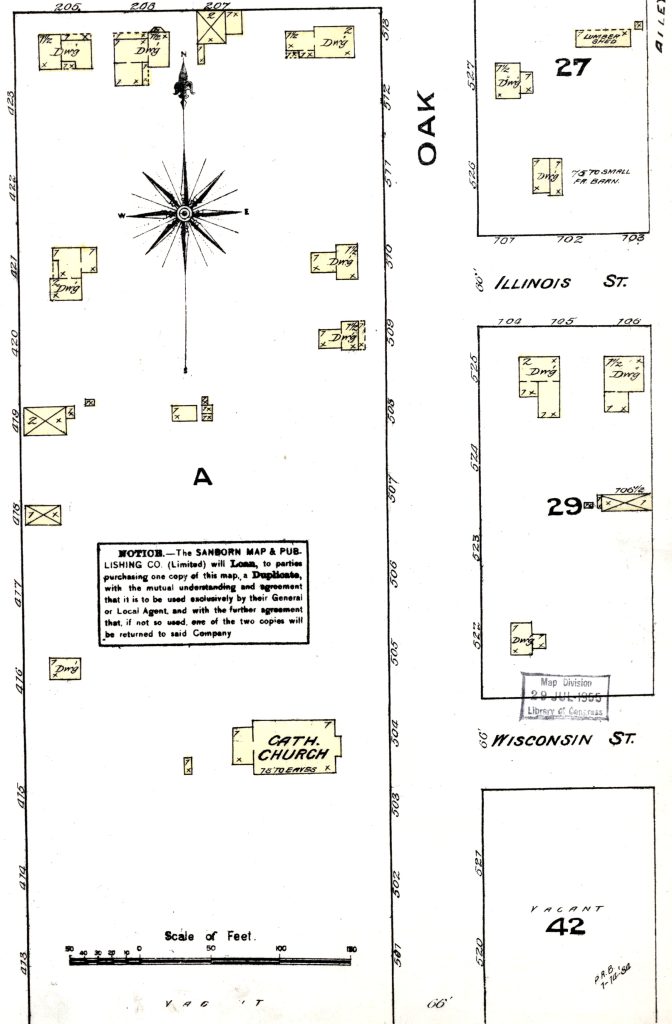
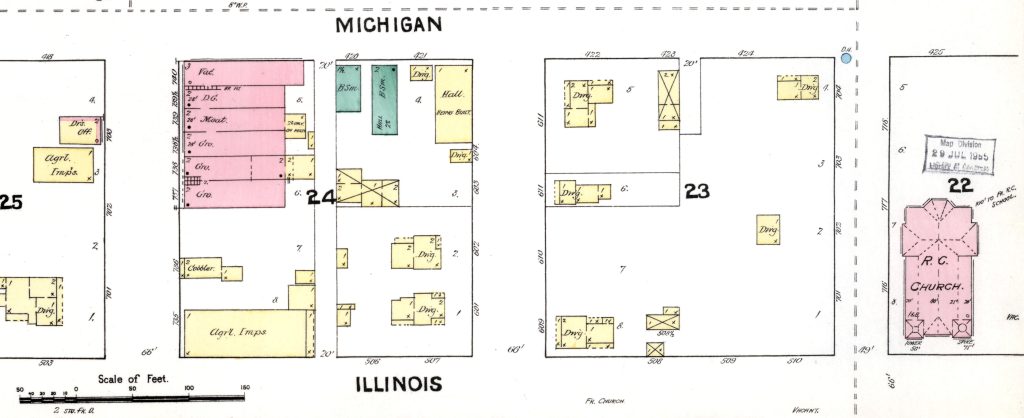
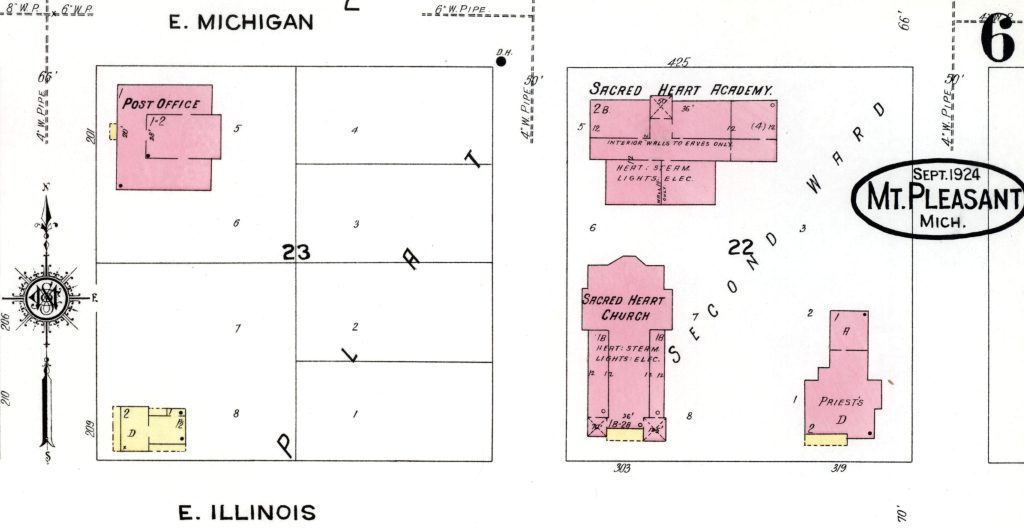
By 1890, the new Sacred Heart Catholic Church (right), finished in 1888, was on Illinois Street. Although outside the area shown by the maps, a note indicates the 1877 St. Charles Church, which became the first Sacred Heart Academy building, was 100 feet away from the church.
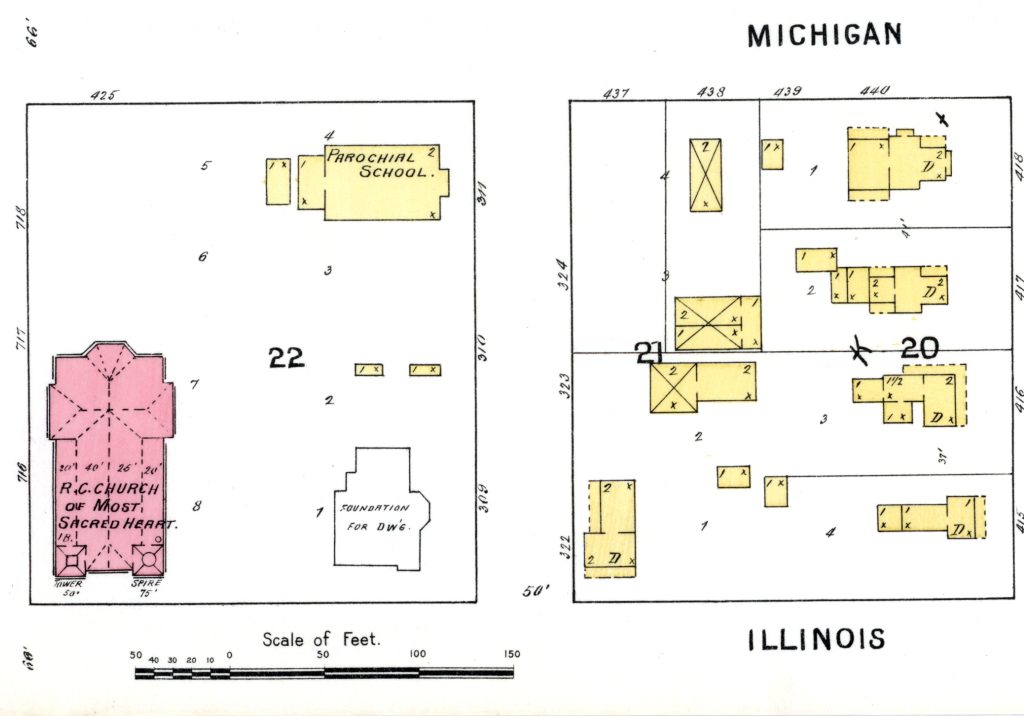
By 1895, we see the 1888 Church, the first Sacred Heart Academy building, and the planned parish rectory, which would be completed in 1900.
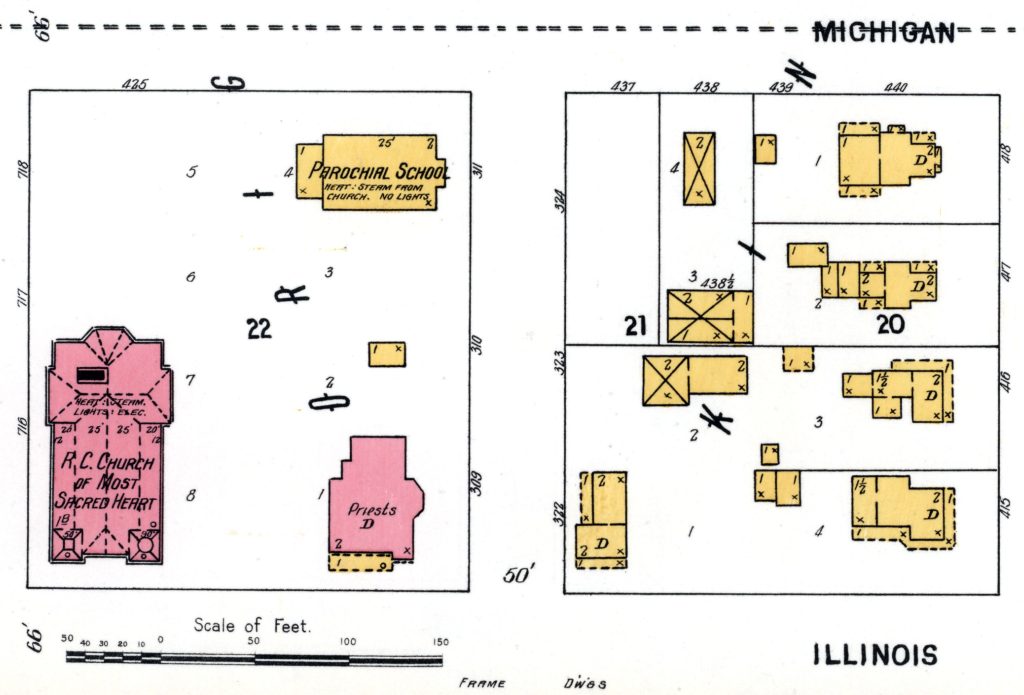
By 1900, the parish rectory had been completed. The first Sacred Heart Academy building was heated with steam from the 1888 Church, and the school had no electric lights.
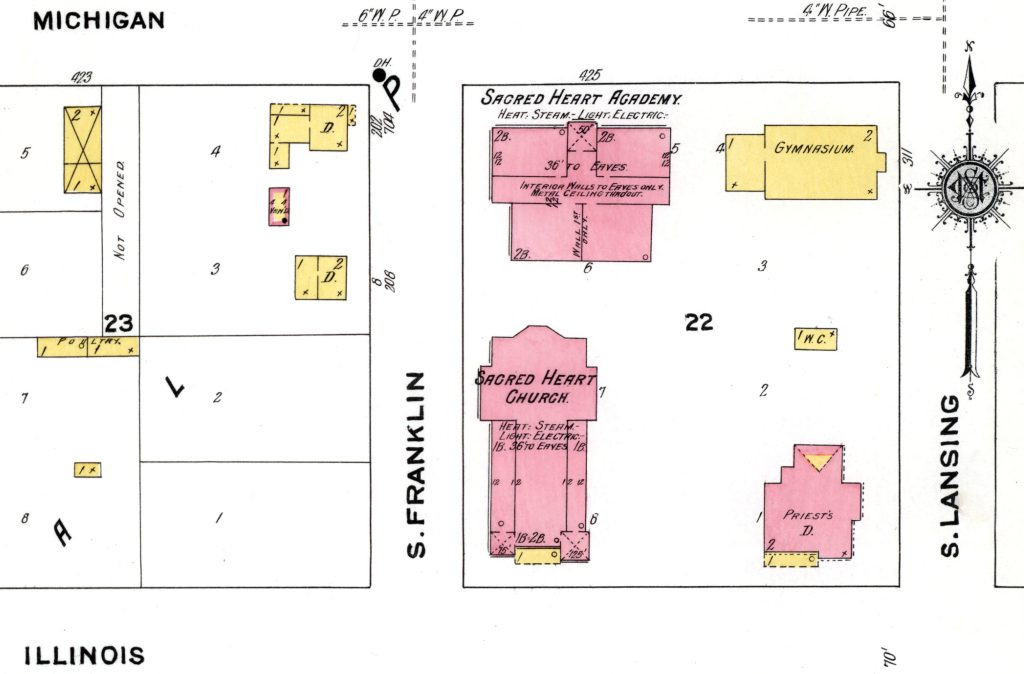
By 1910, the new Sacred Heart Academy building had been constructed in 1908. It had its own steam heat and electric lighting. The first Academy building had been converted to a gymnasium.
By 1924, the second Sacred Heart Academy building had been expanded eastward in 1923, and the first school had been demolished.
Footnotes
- Gabriel Fanning, “Historical Mount Pleasant in Postcards: Posts from Our Past,” in memory of J. Hudson “Hud” Keenan. Online exhibit. Clarke Historical Library, Central Michigan University, August 2026, (https://clarke.omeka.net/exhibits/show/mt-pleasant-postcards/mt-pleasant-postcards: accessed October 16, 2026). “Church Being Moved, Mt. Pleasant, MI,” CHL-RRBPostcards-0131-24-2010, (https://clarke.omeka.net/items/show/3092: accessed October 16, 2026), citing Richard R. Brandell Postcard Collection.
- “Digital Michigan Newspapers,” database, Clarke Historical Library, Central Michigan University (https://digmichnews.cmich.edu/: downloaded 17 October 2026), Isabella County Enterprise, 30 August 1907. “The members of the Sacred Heart church are going to celebrate the 35th anniversary of the establishment of the Catholic church at Mt. Pleasant by giving a grand harvest festival and home coming celebration at Fancher Park, Wednesday, September 11th.”
- “Digital Michigan Newspapers,” database, Clarke Historical Library, Central Michigan University (https://digmichnews.cmich.edu/: downloaded 17 October 2026), Isabella County Enterprise, 4 August 1922. “48th Anniversary to be Observed; Twenty-three Years Service by Fr. T. J. O’Connor; Sacred Heart Parish to Meet Esteemed Pastor Sunday; Sunday, August 6, will be the 48th anniversary of the first Catholic church in Mt. Pleasant, and will complete 23 years pastorate by the genial and beloved Father O’Connor.”
- “Digital Michigan Newspapers,” database, Clarke Historical Library, Central Michigan University (https://digmichnews.cmich.edu/: downloaded 17 October 2026), Isabella County Enterprise, 19 September 1924. “Sacred Heart has 50th Anniversary; Members of Congregation Celebrate Church Founding; The fiftieth anniversary of the founding of the Sacred Heart church of this city was celebrated by a picnic at Kane’s landing Sunday, September 14th.”
- “Isabella, Michigan, United States records,” images, FamilySearch (https://www.familysearch.org/ark:/61903/3:1:3Q9M-C37F-ZBPC?view=explore: downloaded October 27, 2026), I. A. Fancher and wife to Casper H. Burgess, image 279 of 662; Image Group Number: 008580257.
- Isaac A. Fancher, “Past and Present of Isabella County Michigan” (Indianapolis: B. F. Bowen and Company, 1911), pages 237-239.
- “Digital Michigan Newspapers,” database, Clarke Historical Library, Central Michigan University (https://digmichnews.cmich.edu/: downloaded 17 October 2026), Isabella County Enterprise, 27 January 1875, page 1. “Brower & Main furnish all the material for the new Catholic Church which is to be erected in this village the coming season.”
- “Digital Michigan Newspapers,” database, Clarke Historical Library, Central Michigan University (https://digmichnews.cmich.edu/: downloaded 17 October 2026), Isabella County Enterprise, 19 April 1876, page 1. “What has become of the Catholic church building? We hope soon to see it erected, for the more churches and the more denominations, the better for the town.”
- “Digital Michigan Newspapers,” database, Clarke Historical Library, Central Michigan University (https://digmichnews.cmich.edu/: downloaded 17 October 2026), Isabella County Enterprise, 5 July 1876, page 1. “The frame for the new Catholic Church is erected and is a good substantial one, and when completed will be an ornament to our village.”
- “Digital Michigan Newspapers,” database, Clarke Historical Library, Central Michigan University (https://digmichnews.cmich.edu/: downloaded 17 October 2026), Isabella County Enterprise, 19 July 1876, page 4, and 9 August 1876, page 1, and 27 September 1876, page 1.
- “Digital Michigan Newspapers,” database, Clarke Historical Library, Central Michigan University (https://digmichnews.cmich.edu/: downloaded 17 October 2026), Isabella County Enterprise, 5 September 1877, page 1. “Services at the Catholic church to-day.”
- “Digital Michigan Newspapers,” database, Clarke Historical Library, Central Michigan University (https://digmichnews.cmich.edu/: downloaded 17 October 2026), Isabella County Enterprise, 10 September 1879.
- Find a Grave, database and images (https://www.findagrave.com/memorial/132667942/james-mccarthy: accessed 30 October 2026), memorial page for Rev James McCarthy (28 Dec 1854–19 Jun 1885), Find a Grave Memorial ID 132667942, citing Saint Mary Catholic Cemetery, Pittsburgh, Allegheny County, Pennsylvania, USA; Maintained by Kathy Jennings Brown (contributor 47272624).
- O.H. Bailey & Co. “Mt. Pleasant, Michigan.” Map. Boston: O.H. Bailey & Co. Pub., 1884. Digital Commonwealth (http://ark.digitalcommonwealth.org/ark:/50959/x633fd44v: accessed April 30, 2017).
- “Isabella, Michigan, United States records,” images, FamilySearch (https://www.familysearch.org/ark:/61903/3:1:3Q9M-C37F-JVQR?view=fullText: downloaded Oct 21, 2026), image 399 of 663; Isabella County (Michigan). Register of Deeds. Image Group Number: 008580272.
- “Digital Michigan Newspapers,” database, Clarke Historical Library, Central Michigan University (https://digmichnews.cmich.edu/: downloaded 17 October 2026), Isabella County Enterprise, 9 July 1886. “The Catholic society of Mt. Pleasant is in so prosperous a condition and is growing so rapidly that they ardently desire a new church edifice. The church building and surrounding lots will be disposed of when an opportune time arrives, and the society hope to build a church that will be an ornament to our town.”
- “Isabella, Michigan, United States records,” images, FamilySearch (https://www.familysearch.org/ark:/61903/3:1:3Q9M-C37F-DQ9H-5?view=explore : downloaded October 27, 2026), Charles Fantle and wife to Henry Joseph Richter, image 655 of 663; Image Group Number: 008580274.
- “Isabella, Michigan, United States records,” images, FamilySearch (https://www.familysearch.org/ark:/61903/3:1:3Q9M-C37F-DQ9F-5?view=explore: downloaded October 21, 2026), image 325 of 663; Henry Joseph Richter to Toledo, Ann Arbor and Cadillac R.R. Image Group Number: 008580274.
- Isabella County [Michigan] Register of Deeds (https://www.isabellacounty.org/departments/register-of-deeds/services/land-record-search/: accessed October 21, 2026), Liber 48, page 555, Henry Joseph Richter to Ezra S. Gorham, February 20, 1888.
- “Digital Michigan Newspapers,” database, Clarke Historical Library, Central Michigan University (https://digmichnews.cmich.edu/: downloaded 17 October 2026), Isabella County Enterprise, 30 December 1887, page 1. “Father Crowley has sold the property where the Catholic church now stands to Gorham Bros. of Euclid, Ohio, for $3,000. These gentlemen propose to erect a veneering and basket factory on the premises. The Catholic church will be moved to the new site on Michigan street.”
- “Digital Michigan Newspapers,” database, Clarke Historical Library, Central Michigan University (https://digmichnews.cmich.edu/: downloaded 17 October 2026), Isabella County Enterprise, 30 March 1888, pages 1 and 8. “Read the advertisement, “proposals wanted,” for furnishing material for the new Catholic church. Father Crowley will push its construction this season to as near completion as his funds will permit and expects to have it ready for occupation by next fall. The edifice will cost about $15,000 and will be an ornament to the village.”
- “Digital Michigan Newspapers,” database, Clarke Historical Library, Central Michigan University (https://digmichnews.cmich.edu/: downloaded 17 October 2026), Isabella County Enterprise, 18 May 1888 and 22 June 1888, and 29 June 1888, and 13 July 1888, and 20 July 1888, and 17 August 1888.
- “Digital Michigan Newspapers,” database, Clarke Historical Library, Central Michigan University (https://digmichnews.cmich.edu/: downloaded 17 October 2026), Isabella County Enterprise, 20 July 1888, page 1.
- “Digital Michigan Newspapers,” database, Clarke Historical Library, Central Michigan University (https://digmichnews.cmich.edu/: downloaded 17 October 2026), Isabella County Enterprise, 22 June 1888, and 06 July 1888, and 27 July 1888, and 10 August 1888.
- “Digital Michigan Newspapers,” database, Clarke Historical Library, Central Michigan University (https://digmichnews.cmich.edu/: downloaded 17 October 2026), Isabella County Enterprise, 7 September 1888, page 1, and 30 November 1888, page 1. “The frames for the new Catholic church were destroyed in the big Saginaw fire recently. This has delayed the work on the structure. A new lot were made up and have arrived and the work will now be pushed.” “The Catholic church has received its handsome new slate roof. It is a very handsome and conspicuous building.”
- “Digital Michigan Newspapers,” database, Clarke Historical Library, Central Michigan University (https://digmichnews.cmich.edu/: downloaded 17 October 2026), Isabella County Enterprise, 14 December 1888 and 28 December 1888. “Father Crowley says the first services in the new Catholic Church will occur one week from next Sunday four months and one day from the laying of the cornerstone.” “Three masses were celebrated in the Catholic church on Christmas.”
- Isaac A. Fancher, “Past and Present of Isabella County Michigan” (Indianapolis: B. F. Bowen and Company, 1911), page 238.
- “Digital Michigan Newspapers,” database, Clarke Historical Library, Central Michigan University (https://digmichnews.cmich.edu/: downloaded 17 October 2026), Isabella County Enterprise, 19 July 1889. “The old Catholic church building is receiving a stone foundation and will be veneered with brick. This will make a handsome edifice as well as a warm building. It is divide into two school rooms and recitation rooms and seated to accommodate 200 pupils.”
- R. A. Miller and Chas. J. Seely, “Faces and Places Familiar, Mt. Pleasant, Mich.,” (Mt. Pleasant, Michigan: Courier Press, 1906), “Sacred Heart Church and School,” page 39.
- Find a Grave, database and images (https://www.findagrave.com/memorial/101855742/john_a-crowley: accessed 30 October 2026), memorial page for Rev John A. Crowley (13 Aug 1844–12 Jun 1899), Find a Grave Memorial ID 101855742, citing Calvary Cemetery, Mount Pleasant, Isabella County, Michigan, USA; Maintained by C Clingan (contributor 48673246).
- Isaac A. Fancher, “Past and Present of Isabella County Michigan” (Indianapolis: B. F. Bowen and Company, 1911).
- Mr. & Mrs. Lloyd Cole, “Brief Histories of the Churches of Mt. Pleasant” (Historical Study Group, First Presbyterian Church, May 1958).
- Library of Congress, Geography and Map Division, Sanborn Maps Collection. Fire insurance maps. https://www.loc.gov/collections/sanborn-maps/?fa=location_state:michigan%7Clocation_county:isabella+county: downloaded October 16, 2026).
- “Plat book of Isabella County, Michigan / drawn from actual surveys and the county records by C. M. Foote & E. C. Hood.” In the digital collection Michigan County Histories and Atlases. (https://name.umdl.umich.edu/2933874.0001.001: downloaded 3 December 2009). University of Michigan Library Digital Collections.
- Portrait of Fr. John A. Crowley provided by Angela Yondo, Archivist, Catholic Diocese of Grand Rapids, Grand Rapids, Michigan, 13 October 2026.
- My great-grandparents Joseph and Mary Ann (Yuncker) Voisin were married in the 1877 St. Charles Church on 16 February 1885 by Fr. McCarthy. My parents John E. and Ruth P. (Stewart) Voisin were married in the 1888 Sacred Heart Church on 8 January 1948. My father John E. Voisin graduated Sacred Heart Academy in 1943. I graduated Sacred Heart Academy in 1979.
Related Posts:

Thank you for this very detailed analysis and well footnoted article. My maternal ancestors are from Mount Pleasant and probably participated in this event. They were the Careys the Garvins the Kanes and McDonald’s that had moved over from Canada about 1875. The same last names are still graduating from sacred heart academy today!